What are Green Claims?
These are claims that a product, service, or brand provides a benefit or is less harmful to the environment. These claims are used to market their product or service.
Unfortunately with the rise in demand for sustainable products, there are now a proliferation of brands and products claiming to meet that demand. Some of these claims can be misleading or simply not accurate, resulting in ‘greenwashing’. There is now legislation introduced to minimise the amount of greenwashing in the market and combat misleading green claims.
The principles of the UK Green Claims Code legislation are that:
- Claims must be truthful and accurate
- Claims must be clear and unambiguous
- Claims must not omit or hide important relevant information
- Claims must consider the full life cycle of the product or service
- Claims must be substantiated (e.g. backed up by evidence)
There is similar legislation being introduced in Europe, Australia and the USA so it is important to ensure your brand is compliant regardless of where you are based. Additionally, while this legislation does not affect small businesses (although we recommend staying ahead of the legislation and aligning with best practice), we as a retailer are responsible for ensuring the claims on our website are accurate.
How is Wolf & Badger ensuring Green Claims Compliance?
1. Collecting evidence for your sustainability guarantees
We ask you to complete the evidence submission form so that we can ensure your profile and products are accurate and any claims are substantiated. For example:
- Ensuring the country of manufacture is correctly listed for all your products
- All products have % fibre composition listed
- All guarantees are accurate and we have evidence to substantiate the claims made for each guarantee
- Any certifications named on your profile or products are verified
2. Removing unclear and ambiguous information from profiles and products
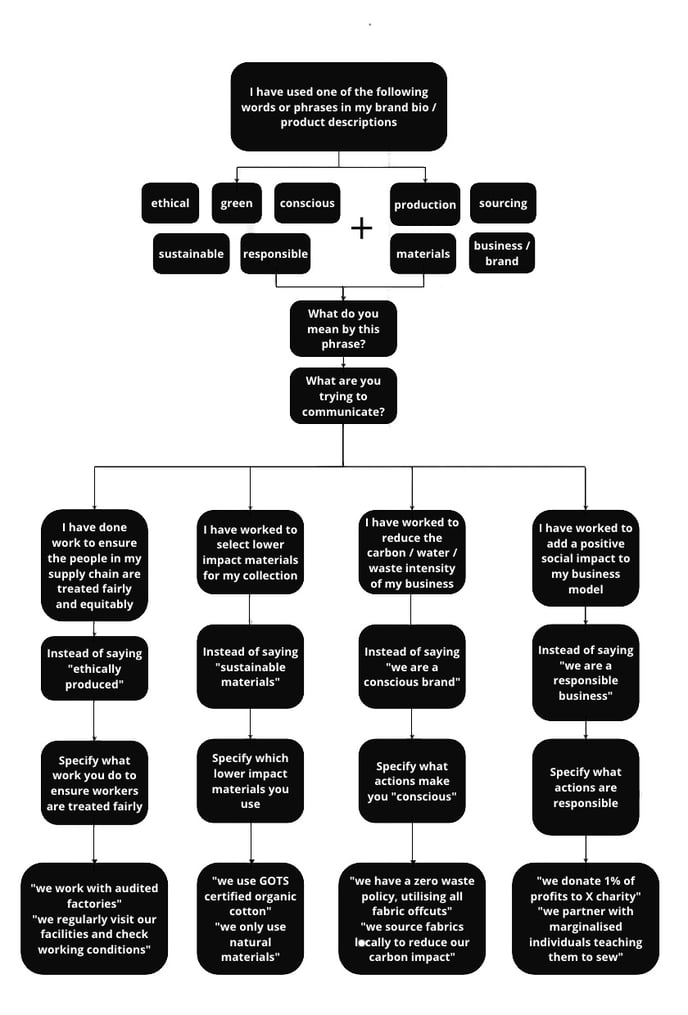
Using terminology such as “sustainable” to describe a product is ambiguous as it does not explain what aspect makes the product more sustainable. Using specific language that explains why a product has a reduced impact compared to others is the best approach for customers to make informed decisions.
Examples of vague terminology that is not Green Claims Compliant:
- “We are a sustainable brand”
- “We use eco-friendly materials”
- “Our products are 100% green”
- “We are good for people and planet”
Alternative options to communicate sustainable attributes of your products:
- “We are working to reduce our impact on the planet through x,y,z example”
- “We use GOTS-certified organic cotton for our products”
- “Our products are made in an audited factory in India to ensure responsible manufacturing practices”
View the flowchart below for further examples of how to avoid greenwashing